Archive for February, 2009

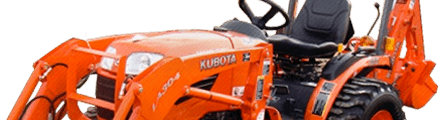
New Kubota L45 Completes TLB Lineup

Kubota's new L45 replaces the outgoing L48 which was discontinued last year.

Kubota's new L45 replaces the outgoing L48 which was discontinued last year.

Rumors of the L45’s arrival have been circling since mid 2008 and earlier this month Kubota officially announced their new L45 tractor-loader-backhoe, part of their TLB series that includes the L39 and the new B26 and M59 models. Previous favorites of this lineup included the L35 and L48, discontinued in 2004 and 2008 respectively. The arrival of this model restores the number of L-series TLB models back to its usual two offerings.

HST Transmssion Introduced
The big changes for the L45 are the introduction of an HST transmission and backhoe thumb controls. Unlike the L39’s glide-shift transmission, a hydrostatic transmission means the L45 can creep along – handy when performing repetitive tasks and you do not want to take your hands off the trigger (or thumb stick in this case).

Dual speed control on the HST pedal also mean not taking your hands off the loader or backhoe controls when shifting gears. Kubota also introduces auto throttle advance which kicks up the throttle automatically if climbing a hill with a load or moving into a pile that would otherwise ordinarily stall the engine. Handy.

Outside cover and inside details of the Kubota's L45 brochure. Click image to see inside.

Outside cover and inside details of the Kubota's L45 brochure. Click image to see inside.

Availability and Pricing
Quotes on pricing for the new model are around $43,000 to $46,000 MSRP depending on having any auxiliary hydraulic kits installed, plus an additional $800-1000 freight and final destination assembly fee. This pricing is a bit above a similarity equipped L48 that Kubota introduced in 2001 for $40,000+. Look for the L45 to show up at your local dealership’s lot this spring or early summer.

Update March 21/2009: Our sources say to look for the L45 to show up at your dealership’s lot within the next couple of weeks (late March early April 2009).

L39 versus L45
The L45 runs on a 4 cylinder, 2.2L power plant and offers a bit more horsepower than its brother model – 45 versus 39 horsepower. Size and weight-wise, the models are comparable with the L45 weighing less than 200lbs more than the L39 and having only a slightly longer wheel base.

L39 versus L45 Specifications

Tractor
Model Horsepower Displacement Transmission Weight Wheelbase
L39 39 1.8L glide shift (GST) 6987 lbs 68.9″
L45 45 2.2L hydrostatic (HST) with dual speed, auto throttle advance and creep modes 7173 lbs 72.5″

The L45 is equipped with a TL1000A loader which is a modified TL1000 found on the L39 and loader specifications are beefier on the L45. The TL1000A increases maximum lift from 2760 lbs to 2848 lbs, and breakout force from 3560 lbs to 4530 lbs. Both tractors have auto leveling loaders.

Loader
Model Loader Max Lift @ Pivot Breakout Force @ Pivot Auto Level
L39 TL1000 2767 lbs 3560 lbs yes
L45 TL1000A 2848 lbs 4530 lbs yes

Backhoe specs are identical between the two models with both boasting 10″ of maximum digging depth and more than 5800 lbs of digging force on the bucket.

Backhoe
Model Backhoe Bucket Dig Force Dipper Dig Force Max Dig Depth
L39 BT1000 5825 lbs 3779 lbs 121″
L45 BT1000A 5825 lbs 3779 lbs 121″

Pictures Wanted
Thinking of buying an L45? Have pictures from your dealer’s lot or trade show? We would love to post up some non-stock photos – mrk@orangetractortalks.com.

Comments (2)

Kubota’s Super Three Engine Series

Kubota Super Three Engine

An article the gives a quick overview of five engine models in Kubota’s Super Three series of engines. Kubota manufacturers these engines in their Tsukuba Japan facility and they are found on modern equipment.

Super Three Engines – Where They Fit In
Kubota’s Super Three engines are 3 and 4 cylinder engines that have an operating range of 2600-2800 rpm and outputs of 29 to 57 horsepower. They are liquid cooled and for the most part, naturally aspirated (only the V2003 is turbocharged). All Super Three engines have a “03″ designation and are found on newer Kubota models as well as third-party equipment that Kubota supplies to (Bobcat, Skylift, track-hoes, etc).

On the lower power end, the “03″ series overlaps a bit on the range of high revving Super “05″ series but covers the 40+ horsepower range nicely until the larger, beefier, V3300 series takes over. Design of the Series Three engines began in 1990 and their production continues today.

Super Three engines, D1403, D1703, V1903, V2203 and V2003 cover the gap from the Super Five to the heavy-hitting V3300 engine models. Horsepower rating runs along the bottom of this chart.

Super Three engines, D1403, D1703, V1903, V2203 and V2003 cover the gap from the Super Five to the heavy-hitting V3300 engine models. Horsepower rating runs along the bottom of this chart.

Low Emissions
Kubota built these engines with low emission technology – the design of the engine lowers the intake temperature and creates a unique air/fuel vortex in the combustion chamber via a concaved recess on the piston head. The result is reduced emissions while still maintaining high output. This low emission engines were built, among other things, to meet the United States EPA’s requirements for lower emissions for agricultural equipment.

A cross-section of the combustion chamber of Kubota's Super Three engine. The fan-shaped concave recess, #7, causes the air/fuel mixture to swirl, #3, in a specific way that yields lower emissions.

A cross-section of the combustion chamber of Kubota's Super Three engine. The fan-shaped concave recess, #7, causes the air/fuel mixture to swirl, #3, in a specific way that yields lower emissions.

This engine series, and the others that Kubota produces that are low emission, is something they are really proud of. Quoted from their industrial engine website:

The ability to produce engines that are capable of clearing all emission regulations is the Division’s driving force in producing advanced, high quality engines of the future.

I’m sure another, unspoken, driving force for the Division is the buckets of cash Kubota reels in from its engine division. They’ve got bills to pay like everyone else.

Engine Specifications
The table below shows layman specifications. For the complete set and for power band graphs, check here.

Kubota Super Three Engines

Model Cylinders Displacement Induction Horsepower Found On
D1403 3 1.4L natural aspiration 29 L2800
D1703 3 1.6L natural aspiration 35 L35, L3240, L3430, L3400
V1903 4 1.9L natural aspiration 40 L3600
V2203 4 2.2L natural aspiration 47 L4240, L4330, L4400, L4630
V2003 4 2.0L turbo charged 57 L3940

Related Articles
A Look at Kubota’s Tsukuba Factory

Comments (1)

A Look at Kubota’s Tsukuba Factory

An aerial shot of Kubota's Tsukuba Japan manufacturing plant.

An aerial shot of Kubota's Tsukuba Japan manufacturing plant.


Photo credit: Kubota Canada click here for larger view

Big Facilities
Kubota has three engine building facilities: Sakai, Sakai Rinkai and Tsukuba plants – named after the cities in which they reside. All are located in Japan on the eastern coast and all are of substantial size. The Sakai plant has been around since before World War II and employs more than 2100 people. The Tsukuba plant, pictured above, covers the largest area at around 83 acres or the same size as 63 American football fields.

These plants in Japan serve as both the facilities for Kubota equipment and engine building. There are research and development centers on site as well as engine emissions testing and compliance labs. Kubota is very keen on meeting and exceeding United States EPA (Environmental Protection Agency) standards. In the photo above it even looks like there is testing area for equipment on the green space bottom left – one can definitely see orange equipment dotted about.

State-Side Operations
All told, the three plants in Japan employ more than 3300 people. In addition, Kubota has two more plants state-side in Georgia, Jefferson and Gainesville. These plants are actually only about a 30 minute drive from one another and together employ another 1700. The Gainesville plant supplies one third of all equipment sold in the United States and manufactures the RTV, BX, lawn tractor and Kubota’s zero-turn models. The smaller Jefferson plant opened in February of 2006, employs 500 and primarily manufactures implements – loaders and backhoes – about 70,000 of them a year!

Serious About Engine Building
Kubota has been known to manufacture tractors for other organizations but some folks do not know that Kubota builds and sells engines not just for their own equipment. You can find Kubota engines in Bobcat, Skylift, Ingersol, Cub Cadet and a ton of other skid steers, mini track-hoes, free standing generators, marine applications, light panels and refrigeration units. It is Kubota’s Industrial Engine Division that handles this demand.

Kubota has dealers that are engine-only and do not have tractors or implements on the showroom floor. Northern Power Products is an example of such a dealership.

Tsukuba the City
The city that resides nearby Kubota’s plant, to the east, actually itself has some history. It is the result of a planned city that Japan started back in the 1960s. The Japanese government has bred the area into sort of a scientific hot spot with numerous research labs, two universities and around 240 private research facilities – all of this in a city of only about 200,000 people. About 50% of Japan’s research and development budget goes to the area. The city hosted the 1985 Expo and has its own very high tech transit system. Read more about it at Wikipedia.

Tsukuba Facility
The Tsukuba plant was built in 1975 and employs about 600 and Kubota manufactures its Super Three series of engines at this plant. The rumors you have heard regarding Japan, robots and a quest for efficiency is true – one third of the assembly line is automated. 15 robots perform basic engine assembly: crankcases, crank gear, pistons, connecting rods – all assembled automatically. 16 CNC robots perform the high precision task of machining engine blocks which leads to improved consistency and quality across the line.

A robot installs pistons on Kubota's automated assembly line.

A robot installs pistons on Kubota's automated assembly line.

Unfortunately we are not allowed to see inside the facility, but, we are still able to see what it looks like from space! Use Google Maps below to explore the Tsukuba facility from a satellite’s perspective. This will have to do until next time we are in the neighborhood to take pictures in person!


View Larger Map

Related Articles
Kubota’s Super Three Engine Series

Comments (1)

Kubota L Series Clutch Repair Pricing

L2350 Clutch Estimate

Wondering how much that clutch job might be for your L series Kubota?

OrangeTractorTalks reader Brian recently requested a quote for what we call a clutch overhaul kit for his L2350. This estimate is for a single disc dry clutch, and although for the L2350, other similar models like L2050, L2250, L2550, L2650 or L3250 would have similar pricing for these clutch components. If you are thinking of tackling this job as a DIY’er, plan on setting aside 8-10 hours – a good long weekend job.

Kubota L2350 Clutch Repair Pricing

Part Notes Price
Clutch Disc replace as a set with pressure plate $97.40
Pressure Plate replace as a set with disc $132.00
Release Bearing $32.39
Release Hub $31.67
Hub Release Return Spring $2.38
Clutch Release Fork often worn and causes binding $28.50
Total $324.34

*prices in USD

Related Articles
10 Tips to Save Wear on your Kubota’s Clutch
Getting to Know your Kubota’s Clutch
Forum: Service, Repair & Maintenance

Comments (3)

7 Must-See Kubota Videos

Kubota Tube

Ahhhh yes, YouTube, now the internet’s number 2 search engine behind Google. There is nothing you cannot find on it, including plenty of videos of Kubotas in action. Remember, watch these in high definition if available. Without further ado, I present to you 7 must-see Kubota videos:

  1. Snowblowing Action Video
    I like this video because it shows what looks to be a Kubota BX24 with a rear snow blower tossing snow 15 feet in the air – what’s not to like? Also at 51 seconds into the video we see a dog with what appears to be a very large udder wander into frame. Worth a look.


  2. Kubota M108 Hauling Bales Like they Weigh 50lbs
    Here we get to see Kubota’s new 108 horsepower M108 in action. It has a pair of pallet forks and spears 2 bales at once and hauls them around – the Kubota does not skip a beat. You will note that at almost 9500lbs, there is no need for this M series to ballast the rear against the weight of those bales. Right around 45 seconds in we get a nice 1st-person view of what it looks like to operate this beast! Watch the video to the end and count how many bales on the trailer.


  3. M9000 Really Stuck
    I’ve posted this video on OrangeTractorTalks before but it is always worth a look. This M9000 is stuck deep in the mud and the suction keeps it there.


  4. Kubota Tug of War
    A couple of guys got together and wanted to settle the question of “in a tug of war between a Caterpillar forklift and a smaller Kubota BX series who would win?” I will not spoil the video for you but I’m guessing that this equipment is not their own.


  5. Box Scraper in Action
    YouTube user wilsonoutdoors brings us a handy video that shows us a box scraper used to grade a driveway. Sometimes we can forget about the trusty box scraper, but this video does that attachment justice. Their other videos include mower decks and stump removal so check those out too.


  6. Abusing Your Father’s Kubota when He’s Not Around
    Here is another video out of the “I do not personally own or pay for this equipment” file. Skip the first 20 seconds and have a look as two teenagers repeatedly ram the equipment into a snow drift and perform numerous, high speed and dangerous doughnuts in a snowy field. Something tells me they will be needing that ROPS sooner than later.


  7. Kubota Export Yard
    I’ve included this short clip of Japanese Domestic Market (soon to be gray market) Kubotas prepped for export from a Japanese shipping yard. These Kubota tractors are due for destinations all over the world and typically collect in yards like these before being distributed by the container load. Just like their newer cousins, the wheels are unbolted and the units undergo minor disassembly for transport. If they are used, like these ones are, they will also be pressure washed as required by the importing country duty and customs department. Most countries have strict regulations when dealing with imported agricultural equipment that still has mud or vegetation on the equipment.


Related Articles
5 Videos of Kubotas that Pull Their Weight

Comments (8)

A Burned up Kubota from Australia

Southern Australia has been in the news lately because of their massive brush fires and the tragic loss of life and homes for those caught in the path of the fire. To date more than 200 people have died and 1800 homes destroyed. It is also upsetting to learn that the fires had been deliberately set.

OrangeTractorTalks reader Keith posted a picture of a Kubota L1801 in our gallery that was involved in those fires. Keith helps run a Kubota restoration and refurbishing shop in Australia and a client had their equipment burned up by the fire.

A burned up Kubota L1801 as a result of Australia's recent brush fires making the news.

A burned up Kubota L1801 as a result of Australia's recent brush fires making the news.

If you look at the full resolution photo, you can see the bubbling on the dashboard, the melted steering wheel, the FEL control knobs are all gone and the rear tire is basically just a rim. Incredibly, Keith reports that the Kubota was still running in this state and they drove it onto the trailer under its own power.

I’ve asked if Keith could keep us posted on the progress of this repair. I think it would be interesting to see what a full restoration looks like. Thank you for sharing Keith!

Mr. K

Comments

« Previous entries