

Archive for November, 2008

eBay Tractor of the Week: L3400

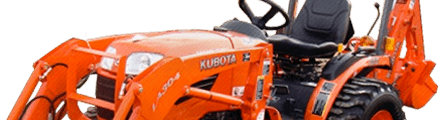
This week we found a very clean and very low hour L3400DT listed on eBay – only 76 hours. The L3400 is powered by a 3 cylinder diesel engine that generates about 35hp, 29hp to the PTO which is plenty enough to power all sorts of implements – exactly what the owner, Steve, has been up to on his 5 acre lot.

This week's featured eBay tractor is a L3400DT from Atlanta - very low hours and comes fully equipped with front end loader, box scraper, mower deck, pallet forks and a post hole digger.

This week's featured eBay tractor is a L3400DT from Atlanta - very low hours and comes fully equipped with front end loader, box scraper, mower deck, pallet forks and a post hole digger.

The tractor is a 4WD as denoted by the DT at the end of L3400DT, and it comes equipped with almost every implement you might need: a front end loader, box scraper for grading the drive way, post hole digger, pallet forks and a mower deck.

This Kubota is located in Atlanta for local pick-up only and is priced very competitively. Currently 3 bids with high bid at $10,000. Considering the condition of the tractor and all the implements included, this is really a complete package – manuals are also included. Auction ends in about 6 days as of this writing, so get on over to eBay and check out Steve’s L3400 (auction #270305908800) which is our eBay tractor of the week.

Update: Steve managed to sell his L3400! High bid was $15100 and the new owner still has a warranty until 2009, powertrain until 2010. Great deal!

Comments

Rattle Can Paint Job: Kubota L2000 Restoration

Hello, Mr. K here! We’ll take a small detour from our latest discussion on how readers at home can paint their own Kubotas, to show off some of the work we have performed lately.

Rattle Can Style
This is a JDM (Japanese Domestic Market or gray market) Kubota L2000 that we recently painted “rattle can style” in our garage at home using the techniques we described in our rattle can paint techniques article. This particular L2000 was manufactured by Kubota in Japan around 1978. Notice that we took a little editorial licence in customizing the appearance of this Kubota. Down the center of the hood we sprayed Duplicolor spray on truck bed liner. It has a unique stippled finish to it and it toughens up the hood a bit and makes your Kubota look like a “sport model”. We also used this spray liner on the lower grille area and the underside of the hood.

A 1978 Kubota L2000 with restored paint using factory Kubota paint and decals

A 1978 Kubota L2000 with restored paint using factory Kubota paint and decals

Decals, Wheels and Muffler
Notice the new Kubota decals on this tractor, they are 100% genuine Kubota inventory and are still readily available today. You’ll notice that the wheels were painted white using Kilz and then reversed to gain a wider footprint yielding additional stability. The muffler and exhaust stack were painted as well.

A side shot of the L2000 detailing the painted frame, muffler and stack, wheels and installed decals

A side shot of the L2000 detailing the painted frame, muffler and stack, wheels and installed decals

Dash Restoration
The dash assembly on this L2000 was not painted, rather it was machine polished and waxed. The rest of the tractor was very faded out, despite the low 349 original hours – the tractor is still 30+ years old. We decided to keep the brake pedals yellow as was factory, and replaced the bright red service point accents as can be seen on the engine air kill lever and the transmission oil fill area.

The dash of the tractor was not repainted but came up really well after machine polishing and using a bit of wax

The dash of the tractor was not repainted but came up really well after machine polishing and using a bit of wax

The paint restoration of this L2000 is just one example of how a few simple techniques combined with the right paint can restore the look of your sun faded tractor in no time!

Mr. K

Related Articles
Kubota Paint – Part Numbers, Where to Apply and How Much
Rattle Can Paint Job: Part 1 – Tractor Prep & Proper Technique
Rattle Can Paint Job: Part 2 – Frame, Engine, Transmission & Wheels

Comments (2)

Rattle Can Paint Job: Part 2 – Frame, Engine, Transmission & Wheels


This is the second article in a series where we discuss how to restore the paint on your favorite orange tractor. If you have not already done so, have a look at Part 1 which covers off tractor prep work and the proper technique when using a spray can.

Painting the Chassis
You will not need to sand or prime the blue chassis of your Kubota. If it’s clean and free of grease then lay down the spray. Starting at the left front corner of the tractor start spraying the chassis. Adjust your vantage point so you can see the wet edge of the paint as it’s applied to the tractor. Overlap each new course of paint approximately 50% over the previous course. Work your way around the entire tractor painting all the blue. Areas that should be painted in Kubota Blue are:

  • front bumper
  • engine block
  • firewall
  • front steering and/or front 4×4 differential
  • transmission and the transmission tunnel (B series)
  • rear axle
  • gear cases
  • 3 point hitch
  • clutch and brake pedals (if you decide to paint them blue)

Your Kubota may have brake pedals that are yellow. It is okay to paint them blue! They are blue on the newer models!

Once you’ve made one complete lap around the chassis and have laid down the first coat of blue, start right back and lay down a second coat in the same manner. This is when you will really see the color fill in and your Kubota tractor chassis will really come back to life. The 3 point hitch arms and lift links may need a third coat. The lift arms seem to show wear a lot more than say the side of the engine block, so spray them well. Once the second coat is done get a trouble light and inspect any of the tight spots for paint coverage. Areas to double-check would be: behind the hydraulic pump, above and to the left of the injector lift pump, the area just above the starter etc. Re-spray as needed to ensure proper consistent coverage.

Devil’s in the Details
Once the chassis is done you can turn your attention to a couple of quick detail items that will really make your repaint job look professional. If you have some semi-gloss black paint in the shop, give the radiator and its shroud a quick once over. If you are careful, you can also shoot the top rad hose. The cloth covered Kubota rad hoses always look dull and old so a little touch-up here looks great.

Next, if you have some clear coat, spray the air box. By spraying it clear you’ll save any of the service instructions printed on the box and it’ll brighten that part right up. Spray the big air intake tube and any small hoses or wiring you see in the engine compartment. Do not worry about masking anything off when using the clear. That’s the beauty of it – it makes whatever it goes on look clean and new.

We apply clear coat to the air box, small hoses or compartments in the engine bay - brightens them up like new.

We apply clear coat to the air box, small hoses or compartments in the engine bay - brightens them up like new.

With the chassis freshly painted and the balance of the engine compartment detailed out, we can now take a look at restoring the appearance of the wheels on your Kubota.

Orange or White Wheels?
Kubota has two shades of Orange spray paint which you can learn about by taking a look at our Kubota Paint Numbers and Coverage Table.

Which shade of orange you use (Orange Enamel vs. Bright Orange II) on your rims will be determined by your tractors vintage. Orange Enamel is a lighter orange with no hint of red. The newer Bright Ornage II is a bit reddish and appears darker when laid beside the older orange.

Early Kubota B and L series tractors, North American and JDM (Japanese Domestic Market/Gray Market) models were all Orange Enamel. The BX tractors, B5200, B6200, B7200, B8200, B9200, the L-1 Series Kubota’s, the M Series and the re-released B7100s were all Bright Orange II. If you’re a stickler for authenticity that may matter on your wheels. But wait! There’s more…

Japanese Domestic Market (gray market) B Series tractors had orange wheels, L Series models like L1500, L1501, L1511, L1801, L2000, L2201, etc, all had orange wheels, Kubota 02 series tractors, the models made in conjunction with Kioti/Daedong had white wheels. You can paint your previously orange wheels white, or your previously white wheel orange. You’ve got a lot of options here. If you are in doubt – post a comment and we can help you with your application.

Wheel Prep
Prior to doing any painting on your Kubota’s wheels, you need to clean them with a surface prep. In earlier times, surface prep was wax and grease remover. Whichever terminology your familiar with you need to thoroughly clean the wheels to remove any surface contaminants like wax, silicone, tire dressings, grease, even finger prints. Wipe down using a paper shop towel, not a rag that’s been moistened as the old rag may transfer back exactly what you’re trying to remove.

After a wipe down on both sides of the wheel rims, use some Windex or other neutralizer to wipe away any trace elements of the surface prep. This will ensure that residue from the prep cleaner does not affect your paint job.

Scotch Brite
The wheels are going to need a little scuff to make sure the paint gets good adhesion. 3M makes a scrubbing product known as Scotch Brite. Using a red Scotch Brite, scuff the wheel rim on both sides. It won’t take much effort but it goes a long way in giving a professional finish.

Next, take some masking tape and mask off the valve stem, and mask completely around the lip of the wheel rim on both sides. A 2 or 2.5” wide masking tape works well here. The masking tape on the rim lip will keep 99% of any overspray from landing on the tire.

Wipe the wheels down one final time with a shop towel to remove any fine sanding dust, it’s now painting time!

The wheel of our Kubota before prep and masking.

The wheel of our Kubota before prep and masking.

We've used 2'' wide tape to mask the wheels on our Kubota.

Wheels after prep, masking and painting.

Wheels after prep, masking and painting.

Painting the Wheels
The wheels are going to need two coats of paint to adequately cover any nicks and bare spots on them. The first coat should be lighter than the second. Do not worry too much about uniformity of gloss on the first coat – you can take care of that on the second and final coat. When laying down the second coat make sure you can see the paint laying down on the rim. You’re going to want to see a wet edge as you cover all areas of the rim. Overlap as you did with the frame/chassis, and the wheels will look awesome when you are done.

A Helpful Tip for White Wheels
If you are painting the white wheels on a JDM Kubota 02 Series tractor, (L1802, L2002 etc), we found that Kilz brand aerosol primer and stain blocker does an incredible job covering the wheels. It’s inexpensive and readily available at your nearest Home Depot. The finish is a little flatter in gloss than the original paint shade, but the overall coverage and no run application makes the job a snap. Kubota does make white wheel paint; Kilz is a great over-the- counter alternative.

Kilz in a spray can is an over the counter alternative to Kubota's white paint

Kilz in a spray can is an over the counter alternative to Kubota's white paint

Kilz applied to our Kubota's wheels.

Kilz applied to our Kubota's wheels.

After you’ve laid down the second coat and are satisfied with the overall level and consistency of the gloss, remove the masking tape from the wheel lips and the valve stems. You’ll probably have some light overspray of paint onto the rubber sidewalls of the tires. To remove the overspray on the tires, simply moisten a shop towel with a good quality enamel reducer or thinner. You’ll find the light overspray wipes off real easy.

Next Steps
Now that the chassis and frame is nice and blue, the engine bay and radiator is detailed and the wheels are fresh – we are ready to move onto preparing the fenders, hood and dash for paint in Part 3 of this series. Set the wheels aside for now, they’ll get reinstalled after the fenders get painted.

Related Articles
Related Articles
Kubota Paint – Part Numbers, Where to Apply and How Much
Rattle Can Paint Job: Part 1 – Tractor Prep & Proper Technique
Rattle Can Paint Job: Part 3 – Fenders, Hood and Dash

Comments

Rattle Can Paint Job: Part 1 – Tractor Prep & Proper Technique

Forward by Mr. K: This is the first in a four part series where we cover how to improve the cosmetics of your sun-faded Kubota. We take you through the stages from cleaning and prep to priming, painting and installing fresh decals. You will need to know Kubota’s paint part numbers and which type of paint reducer is best for your application in order to get the most out of this tutorial.

The Rattle Can Paint Job
If you own an earlier B or L series Kubota tractor, you already know that the paint, now 25+ years old, looks faded and dry, dull and powdery, rusty and thin. That is the curse of Kubota paint! There is a great way to restore the pride of ownership of your Kubota tractor and that’s with a new paint job! In the following four posts we’ll show you how over the course of a weekend you can dramatically improve the appearance of your Kubota with a few spray cans and some time honored body shop techniques. A small investment of time and money will produce professional results and a Kubota that looks a lot less than 25 years old!

A late 1970s Kubota L2000 that has been repainted using some careful preparation, a spray can and the techniques described in this article

A mid 1970s Kubota L2000 that has been repainted using some careful preparation, a spray can and the techniques described in this article

The Wash Rack
Step one in your rattle can paint job starts with a good through cleaning and degreasing of your Kubota. It helps to have a pressure washer to assist in blasting off dirt and grime. You may consider loading your Kubota onto a car trailer and take it to the local car wash if you have poor pressure from your garden hose. The point being – a great paint job, even on a Kubota tractor starts with a clean substrate, so don’t skimp here – really make a good effort to clean your tractor.

A Kubota B6200 with sheet metal removed before a much needed wash and engine degrease

A Kubota B6200 with sheet metal removed before a much needed wash and engine degrease

Start by using an engine cleaner, like Gunk’s Engine Brite, spraying it on the engine, transmission, differentials, wheels and tires. In the absence of an engine shampoo, a good all purpose non-butyl type of degreaser may also be employed. Apply the degreaser liberally to all parts of the tractor and allow the product to dwell for several minutes before hosing or pressuring off. Rinse the tractor well to remove trace soap and cleaner that could be a problem later.

Once the wash job is done it is not a bad idea to fire up the air compressor and using a blow gun tip blow out the nooks and crannies. Try to push as much water out as possible. In the absence of an air compressor you may want to let the tractor stand for a few hours and let evaporation do the job.

Painting in the Shop or Field?
It is possible to paint your Kubota tractor outside providing you have the correct ambient temperature necessary for painting. Too cold, and the paint will run and pool, never properly curing. Too hot, and the paint will flash dry making it very difficult to carry forward a wet edge necessary in achieving a uniform gloss. You’ll also need to consider wind and insects if you decide to paint outside. Bugs and small black things with wings are attracted to fresh Kubota orange paint. Painting in a shop is the best choice because you can better control the environment.

In order to get the best possible paint result some disassembly of your Kubota is required. Thankfully, this can be done in about a 30-45 minutes for most B and L series so it is not a big deal. Start by:

  1. jacking up the tractor with a floor jack, blocking it up as you go
  2. remove the wheels – make sure to put the washers and nuts back onto the studs so they get painted
  3. remove the rear fenders
  4. remove the seat
  5. remove the hood
  6. remove the battery
  7. (optional) remove the exhaust if it is in the way by undoing four 12mm nuts

At this point you need to decide whether or not the instrument cluster/dash assembly on your Kubota actually needs repainting. We’ve had good success on several other Kubota’s by machine polishing and then waxing this part rather than dismantling it off the tractor. Once polished and waxed it looks pretty good, very acceptable – the choice is yours really. If you do decide to disassemble the dash, you will need to pull the steering wheel, unhook the wiring and remove gauges. For the Kubota we are demonstrating on here, we took the route of removing the dash assembly as well.

Masking Tape – Use It
With all the orange parts removed from your Kubota you are ready to start masking a couple of things up before laying down the Kubota blue chassis and engine paint. Absolutely nothing says amateur paint job better than an upper radiator hose that is covered in paint, a black radiator that is over-sprayed blue or a starter motor the wrong color! Use some masking tape and paper or use a cardboard scrap to shield those areas while spraying. Do not forgot to mask off the serial number and model identification plate, and cover the air box.

How to Use a Spray Can Properly
It occurred to me that now might be a good time to talk a little about how to properly use a spray can. First, if the instruction on the can says to “shake well for 2 minutes” it means 2 minutes, not 10 seconds. A Kubota spray paint can takes about a minute of shaking before you will hear the ball bearing in the can break free. Once the bearing is moving inside the can, the paint will mix quicker. Shake for 2 minutes!

When applying the paint, expect your index finger to get real sore, real fast. That is because when using a spray can, you depress the nozzle at the beginning of each pass, and at the end of that same pass. Do not simply push the nozzle down and then move your arm around all over the place. Painting with a spray gun or spray can is methodical and controlled. The paint must be applied in such a manner as to allow the applicator to see the wet edge of the paint being applied and then overlap the subsequent pass, again pushing a wet edge of paint.

You need to make sure that as you come to the end of your pass your arm is kept at the same distance from the surface as when you started your pass. What can happen is your arm moves in an arc getting gradually further away from your work as you move the spray can from say left to right. Train yourself to reposition your body to compensate for this natural arc.

A spray can adapter can save your trigger finger and makes a can easier to use

A spray can adapter can save your trigger finger and makes a can easier to use

Take a look at your favorite auto parts store for a spray can or gun adapter. It’s a handy, low cost device that snaps onto the top of a spray can and allows you to have a trigger pull on the spray can. Turns your can into mini spray gun!

Personal Protection
Do not forget a couple of personal protection items you’ll need to have to pull this paint job off. You’ll need:

  • a few pairs of disposable rubber or latex gloves
  • good quality paint or strain grade respirator (not a flimsy white paper one)
  • shop coat or apron
  • safety glasses

At this point we have the right paint in the right quantity, a cleaned, disassembled tractor, we know how to spray and we have our gloves and respirator on. In Part 2, we discuss the details of painting the chassis, engine, transmission and wheels.

Related Articles
Kubota Paint – Part Numbers, Where to Apply and How Much
Rattle Can Paint Job: Part 2 – Frame, Engine, Transmission & Wheels
Rattle Can Paint Job: Part 3 – Fenders, Hood and Dash

Comments

How to Bleed Kubota Fuel Injector Lines

Sooner or Later…
It’s not a matter of if you’ll ever have to bleed the injector lines on your Kubota, it’s quite simply when. Throughout the course of regular maintenance this procedure will come up a few times and you’ll be prepared to pull this basic service job off with these tips.

Why is Bleeding Necessary?
Bleeding the injector lines is necessary when you’ve run out of fuel, or have changed a fuel filter and have introduced an air gap into an otherwise closed system. This air gap will prevent fuel from getting to the engine and will stall your equipment – not good. There are two methods to bleed this system, one using the bleed valve and cylinder head decompression, and the other involves loosening the injector lines from the injectors. Either method is a straightforward procedure.

Bleed Valve and Cylinder Head Decompression
The first method purges air between the fuel filter bowl and the injector pump. This air lock is what commonly occurs whenever a fuel filter has been changed. Open the fuel bleed valve located on the side of the injection pump by rotating fully counter-clockwise.

Open fuel bleed valve on side of injection pump by rotating counter-clockwise

Open fuel bleed valve on side of injection pump by rotating counter-clockwise

Next pull on the cylinder head decompression knob to decompress the engine and relieve any cylinder head compression. This photo shows the cylinder head decompression lever with the cable pull removed for clarity – ordinarily you have a knob on the dashboard and that cable attaches to the lever shown below. By relieving the compression, the engine will crank over much faster because it’s not fighting that compression which cycles the injector pump and because the fuel bleed valve is open, the line will clear of air.

Pull on the cylinder head decompression lever and crank the engine for 10-15 seconds

Pull on the cylinder head decompression lever and crank the engine for 10-15 seconds

Crank over the engine for 10-15 seconds, close the fuel bleed valve and attempt to start the tractor as you would normally do (don’t forget to preheat your glow plugs).

Bleeding to Top of Injectors
If your Kubota fails to start, then you’ll need to bleed the lines all the way to the top of the injectors themselves. To do this, locate the injector lines and notice where they enter the top of the injectors.

Locate injector lines on top of injectors

Locate injector lines on top of injectors

Your Kubota tractor will have either 2, 3 or 4 injector lines and all of them will require have to be burped. Using a 17mm wrench (everything is metric on a Kubota), loosen the nut holding the injector line into the top of the injector.

Loosen all injector lines from the injectors using a 17mm wrench

Loosen all injector lines from the injectors using a 17mm wrench

With these nuts well backed off, grasp the injector line and tug upwards on the line to disengage the steel line from the top of the injector. Once you’ve unseated all the injector lines, open the fuel bleed valve on the side of the injector pump (as discussed above), pull on the decompression knob to relieve the cylinder head of any compression, and then turn the key and crank over the engine.

While cranking the engine over, watch for diesel fuel to spurt out of the ends of the loosened injector lines. When you can clearly see evidence of fuel spitting from each line stop cranking the engine, close the fuel bleed valve, release the decompression knob, and tighten up the nuts holding the injector lines. Once tightened, congratulate yourself on bleeding your Kubota Tractors injector lines!

Every Kubota tractor owner will run eventually run the engine right out of fuel. Sometimes that fuel guage just isn’t big enough!

Service Department Vic

Related Articles
Gray Market Kubota Fuel Filter Part Numbers
Are you “gellin’”? A Tip for Cold Climate Kubotas
Cold Weather Starting Tips
Forum: Service, Repair & Maintenance

Comments (38)